
Stock Meadow · Insider Trade Tracker
Insider trading tracker: see what company insiders buy and sell
The Insider Trade Tracker gathers the open-market stock purchases and sales that company officers, directors and 10% owners report to the SEC, so you can see the biggest trades, where several insiders are buying together, and which companies and insiders are most active.
What company insiders must file
The officers and directors of a US-listed company, and anyone who owns more than 10% of its shares, are allowed to buy and sell its stock. They must also report each trade to the Securities and Exchange Commission, in public, on a Form 4.
- Who: officers (such as the CEO and CFO), directors and 10% owners.
- What: a change in how many shares they own, including purchases and sales on the open market.
- When: within 2 business days of the trade, which is why the figures are much fresher than Congress disclosures.
- How much: the exact number of shares and the price, so the tracker can add up real dollars.
| Field | What it tells you |
|---|---|
| Insider | The person or entity that filed, and the relationship they filed: director, CEO, CFO, other officer or 10% owner |
| Company | The ticker and company, linked to the stock's page |
| Trade | A purchase or a sale, with shares, average price and dollars |
| Filed and traded | The day the Form 4 was filed and the day of the trade, with a link to the filing on the SEC's site |
What you can see and do
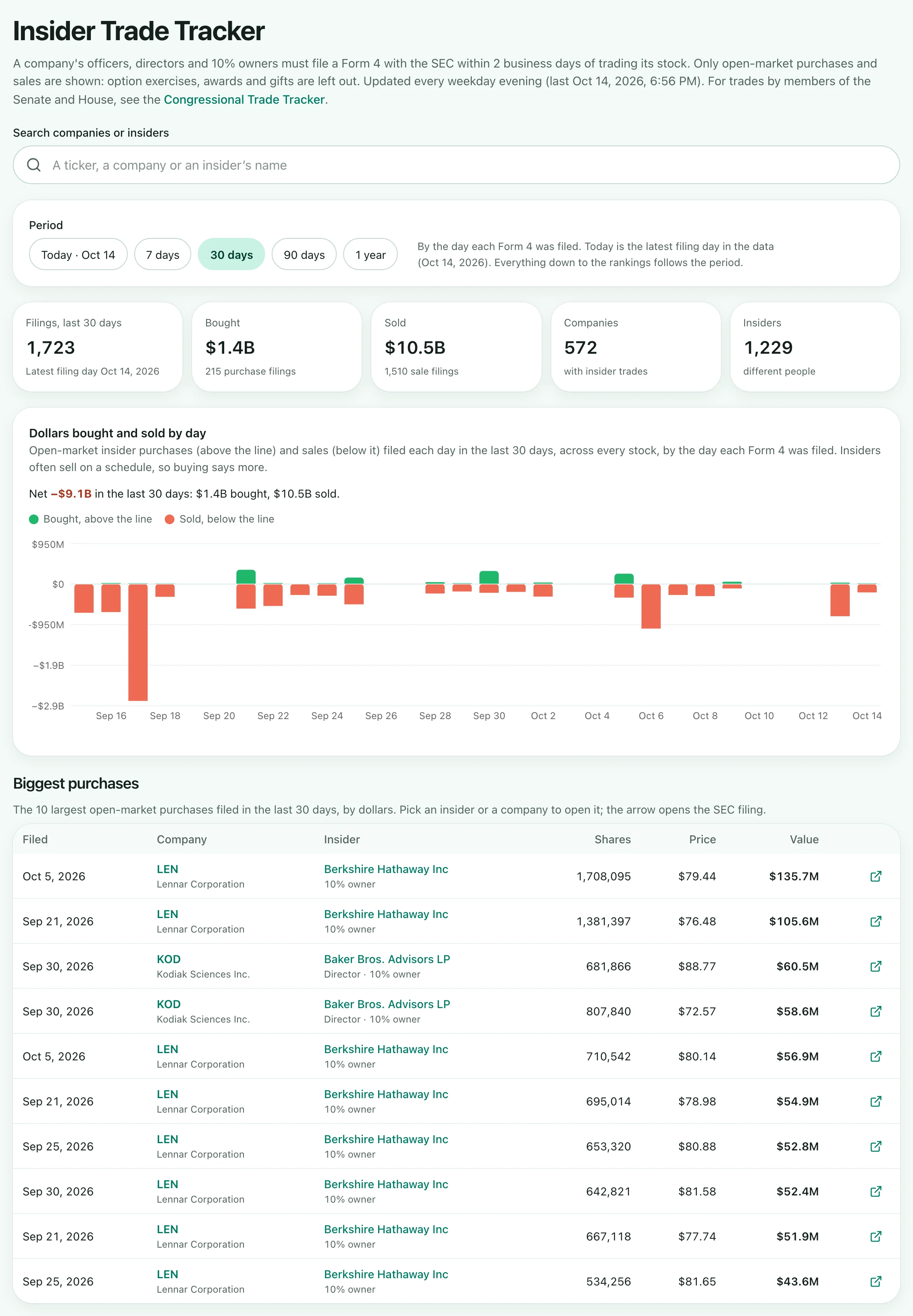
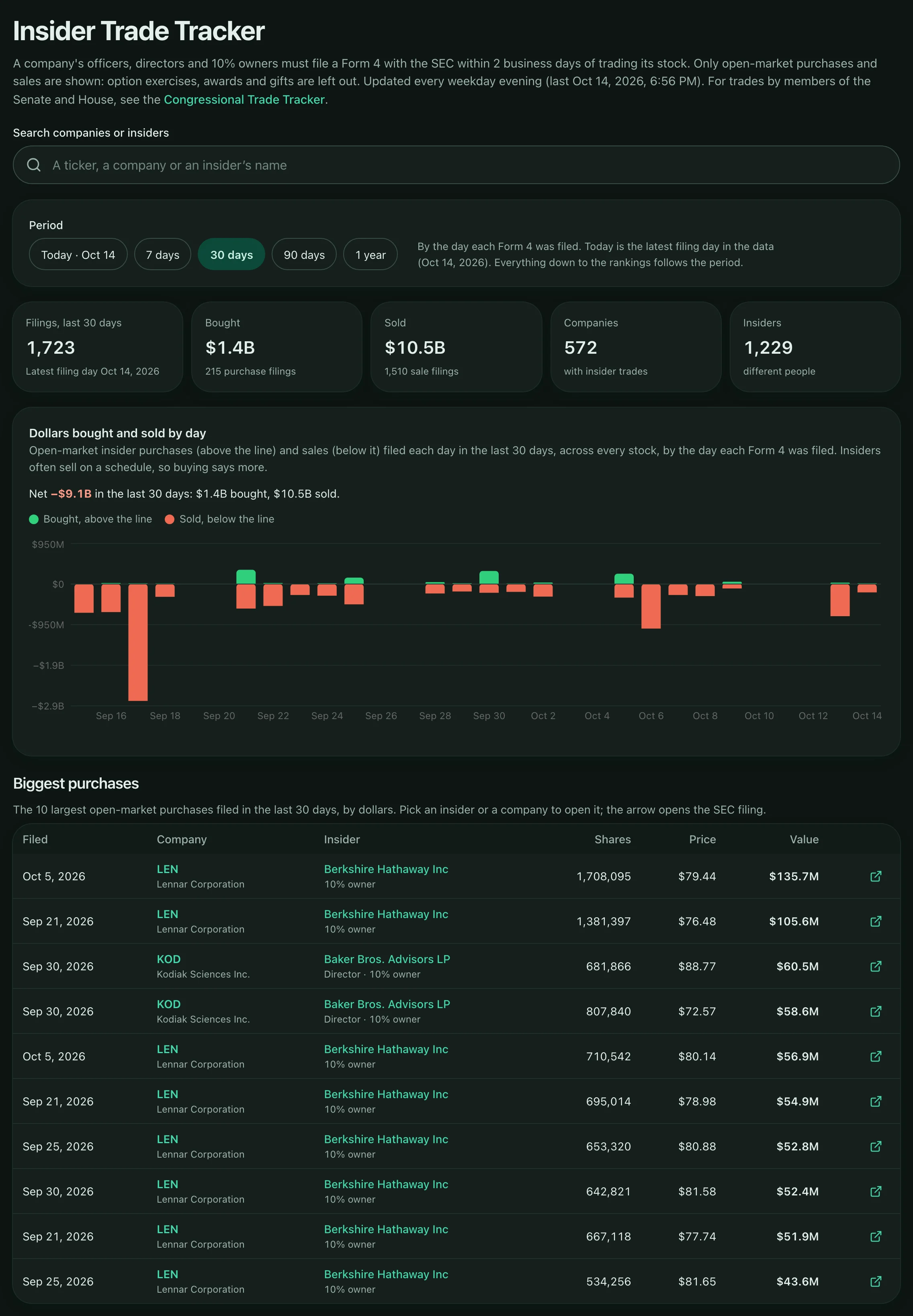
- Switch the period: Today (the latest filing day), 7 days, 30 days, 90 days or 1 year, counted from the day each Form 4 was filed. The tiles, the chart and every ranking follow.
- Count tiles: how many filings, how many dollars were bought and sold, and how many companies and insiders were involved.
- Bought against sold: a chart of dollars bought above the line and sold below it, by day, week or month depending on the period.
- Biggest purchases and sales: the ten largest trades in the period, with the insider, their role, the company and a link to the filing.
- Cluster buying: companies where 3 or more different insiders each bought at least $25,000 in the period, so small same-day plan purchases don't count. Several insiders buying together can say more than one large purchase.
- Most active: the companies and insiders with the most filings.
- Search: type a ticker, a company or an insider's name to open a company view or an insider profile with every filing we keep.
- Latest filings: a list you can filter by buy or sell, role (CEO, CFO, other officer, director or 10% owner) and ticker.
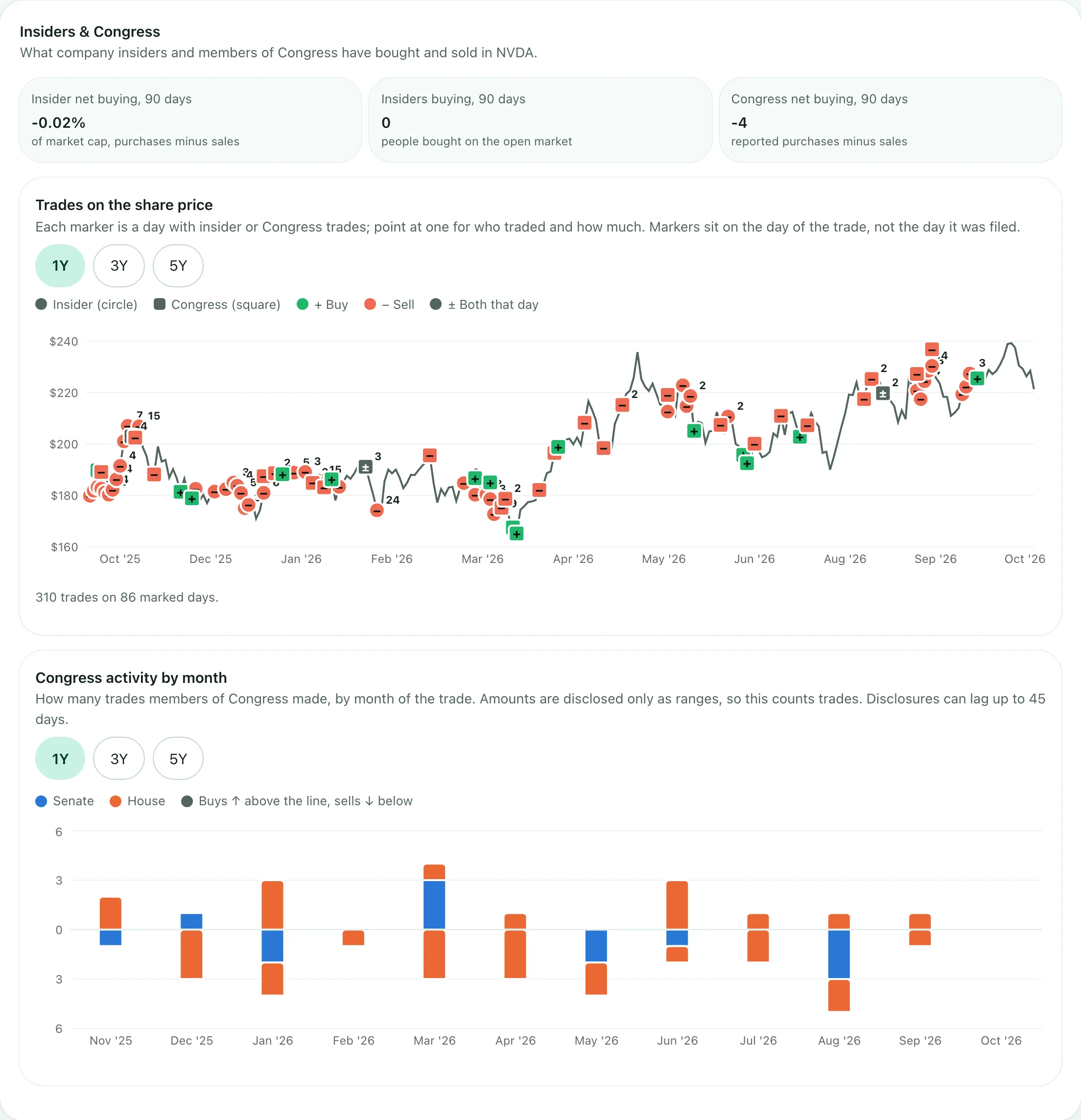
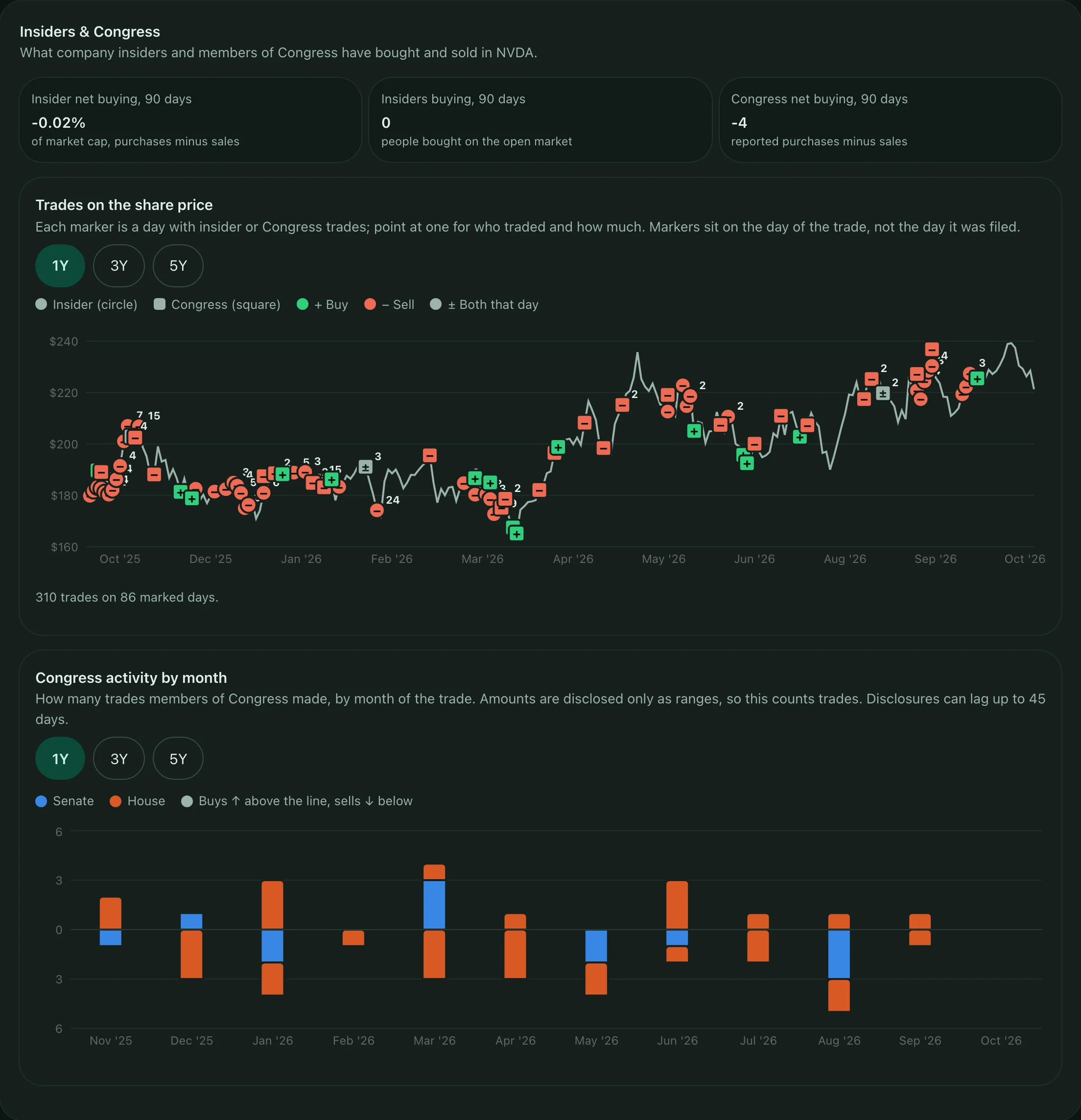
- On every stock: the stock's Congress & Insiders tab charts 5 years of insider purchases and sales next to trades by members of Congress.
The tracker in pictures
Real screens from the app, in the app's light and dark themes.
How often it updates, and how far back it goes
The filings are refreshed every weekday evening, together with the rest of Stock Meadow's data, and the tracker says when it was last updated. The periods count from the latest filing day in the data, and the lists reach back 5 years for a single company or insider.
What the tracker leaves out
- Everything but open-market trades. Option exercises, stock awards, tax withholding and gifts are left out.
- Why a sale was made. Insiders often sell on a pre-set schedule or to pay taxes, so a sale says less than a purchase.
- Other filings. Only Form 4 purchases and sales appear, for the US-listed stocks Stock Meadow covers.
- The newest days. A filing can arrive up to 2 business days after the trade, so the latest days can be incomplete.
A trade by an insider says nothing by itself about how a stock will do, and Stock Meadow does not suggest copying anyone's trades. The tracker is a research tool, not investment advice.
Who can use it
The Insider Trade Tracker is for members. Sign up free for a 14-day trial with no card, then $15 a month or $150 a year (see pricing). It sits beside the Stock Meadow scoring models and the Congressional Trade Tracker: you can score and rank stocks, then check what their insiders and Congress have been trading.
Frequently asked questions
- Is insider trading illegal?
- Trading on material information the public does not have is illegal. But officers, directors and large shareholders also buy and sell their own company's stock legally, and they must report every such trade to the SEC on a Form 4. Those public filings are what the tracker shows.
- How soon after a trade does it show up?
- An insider must file a Form 4 within 2 business days of a trade. The tracker is refreshed every weekday evening, so a trade usually appears within a few days. It shows both the day of the trade and the day it was filed, with a link to the SEC filing.
- Which trades are included?
- Only open-market purchases and sales (SEC transaction codes P and S). Option exercises, stock awards, tax withholding, gifts and other transactions are left out, because they say little about what an insider thinks of the shares.
- Does a big insider purchase mean a stock will rise?
- No. Insider buying is one signal among many, and a purchase says nothing certain about the future. Insiders also often sell on a pre-set schedule or to pay taxes, so a sale says less than a purchase. Stock Meadow is a research tool, not investment advice.
- Do I need an account to use it?
- Yes, the tracker is for members. Signing up is free and starts a 14-day trial with no card needed; after that it is $15 a month or $150 a year. Without an account you can look around the rest of the app in the guest preview, but the tracker shows a sign-up prompt.
Try the Insider Trade Tracker
Sign up free for a 14-day trial, no card needed, then open the tracker. Already a member? Go straight in.
Open the tracker