
Stock Meadow · Congressional Trade Tracker
Congress stock trading tracker: see what members of Congress buy and sell
The Congressional Trade Tracker gathers the stock purchases and sales that US senators and representatives disclose, so you can see which stocks and which members are most active, search any member or stock, and look back 5 years.
What members of Congress must disclose
Senators and members of the House of Representatives are allowed to own and trade stocks. Since the Stop Trading on Congressional Knowledge (STOCK) Act of 2012, they must also report their trades in public.
- Who: each member, and their spouse and dependent children. The tracker shows who held the asset, as the report says.
- What: purchases and sales of stock worth more than $1,000.
- When: within 30 days of being told about the trade, and no later than 45 days after it happens. That delay is why every figure on the tracker is a little behind the market.
- How much: as a range, such as $1,001 - $15,000 or $15,001 - $50,000, not an exact amount. The tracker counts trades rather than adding up dollars for this reason.
| Field | What it tells you |
|---|---|
| Member | The member's name, their chamber (Senate or House) and state, or state and district |
| Stock | The ticker and company, linked to the stock's page |
| Trade | A purchase or a sale, and whether a sale was partial |
| Amount | The range the member reported |
| Held by | Whose account it was, such as the member or a spouse, as the report says |
| Traded and disclosed | The day of the trade and the day the report was filed, with a link to the filed report |
What you can see and do
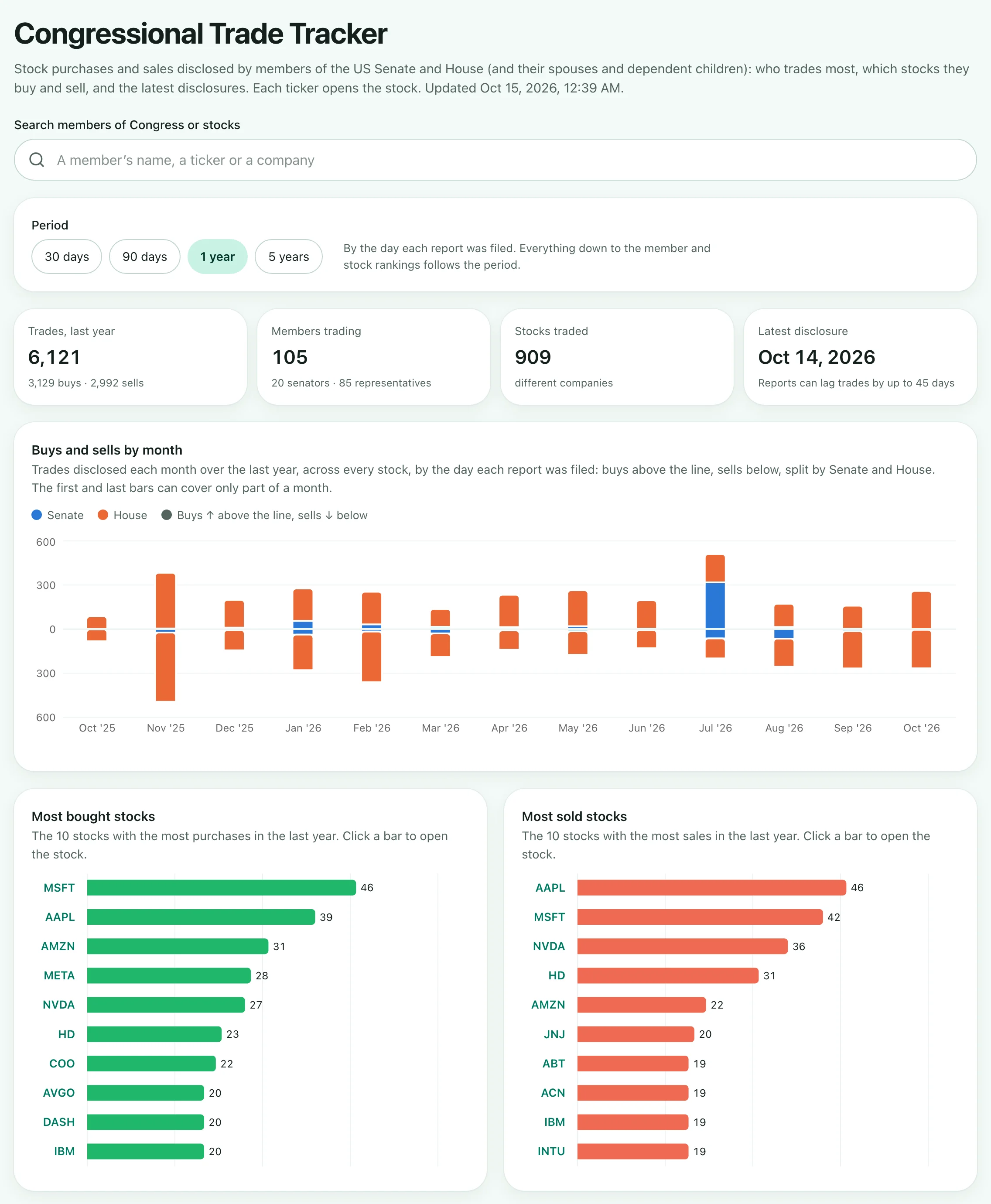
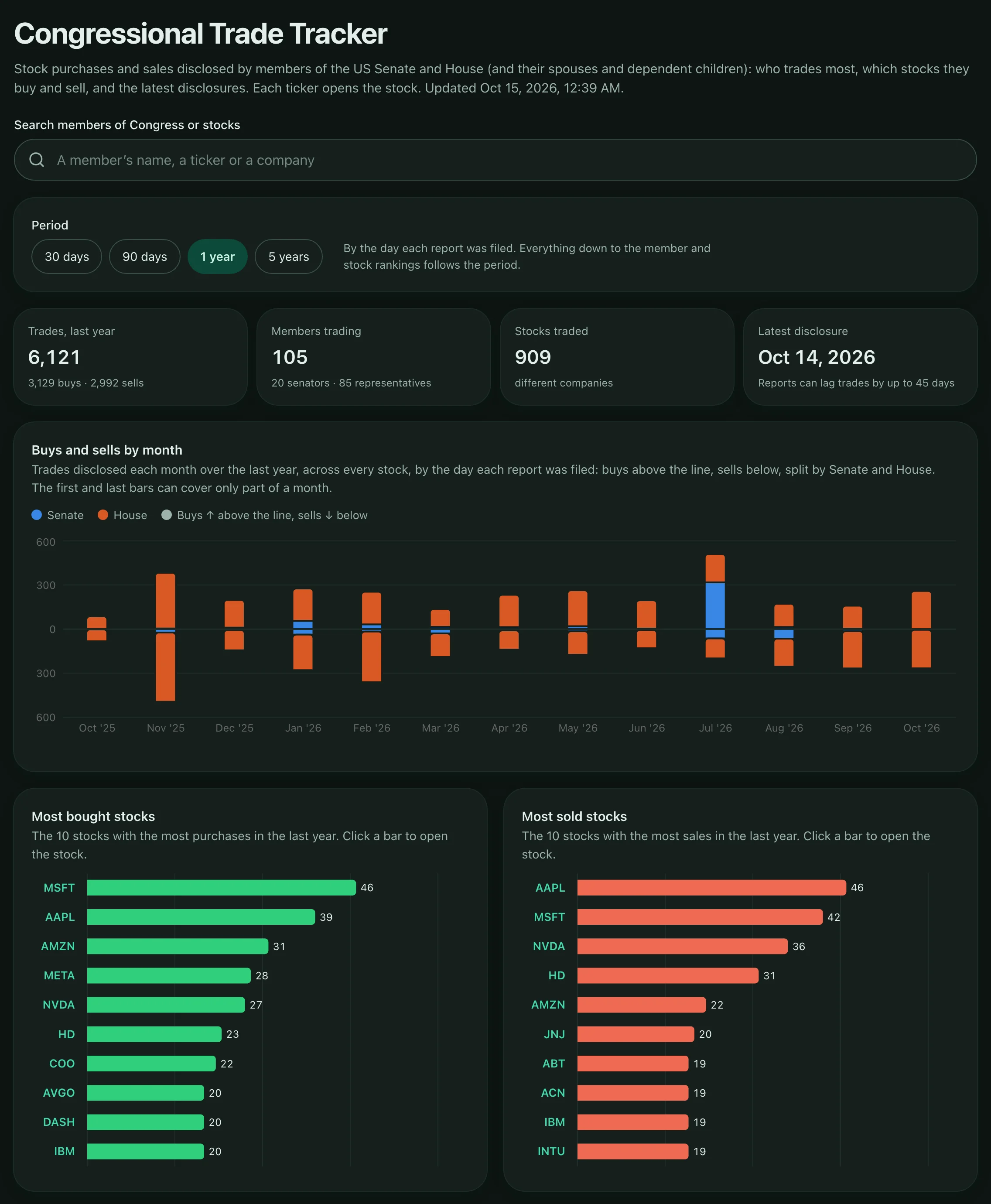
- Switch the period: the last 30 days, 90 days, 1 year or 5 years, counted from the day each report was filed. The counts, the chart and every ranking follow.
- Count tiles: how many trades, how many were buys and sells, how many members traded, how many different stocks, and the latest disclosure.
- Buys against sells: a chart with buys above the line and sells below it, split between the Senate and the House, by day, week or month depending on the period.
- Most bought and most sold: the stocks members bought and sold most often in the period. Click a bar to open the stock.
- Most active members: who trades most, with their buys, sells and latest disclosure.
- Most traded stocks: the stocks with the most trades, and how many members traded each.
- Search: type a member's name, a ticker or a company to open a member profile or a stock view with every trade and a link to the filed report.
- Latest trades: a list you can filter by chamber, buys or sells, and ticker.
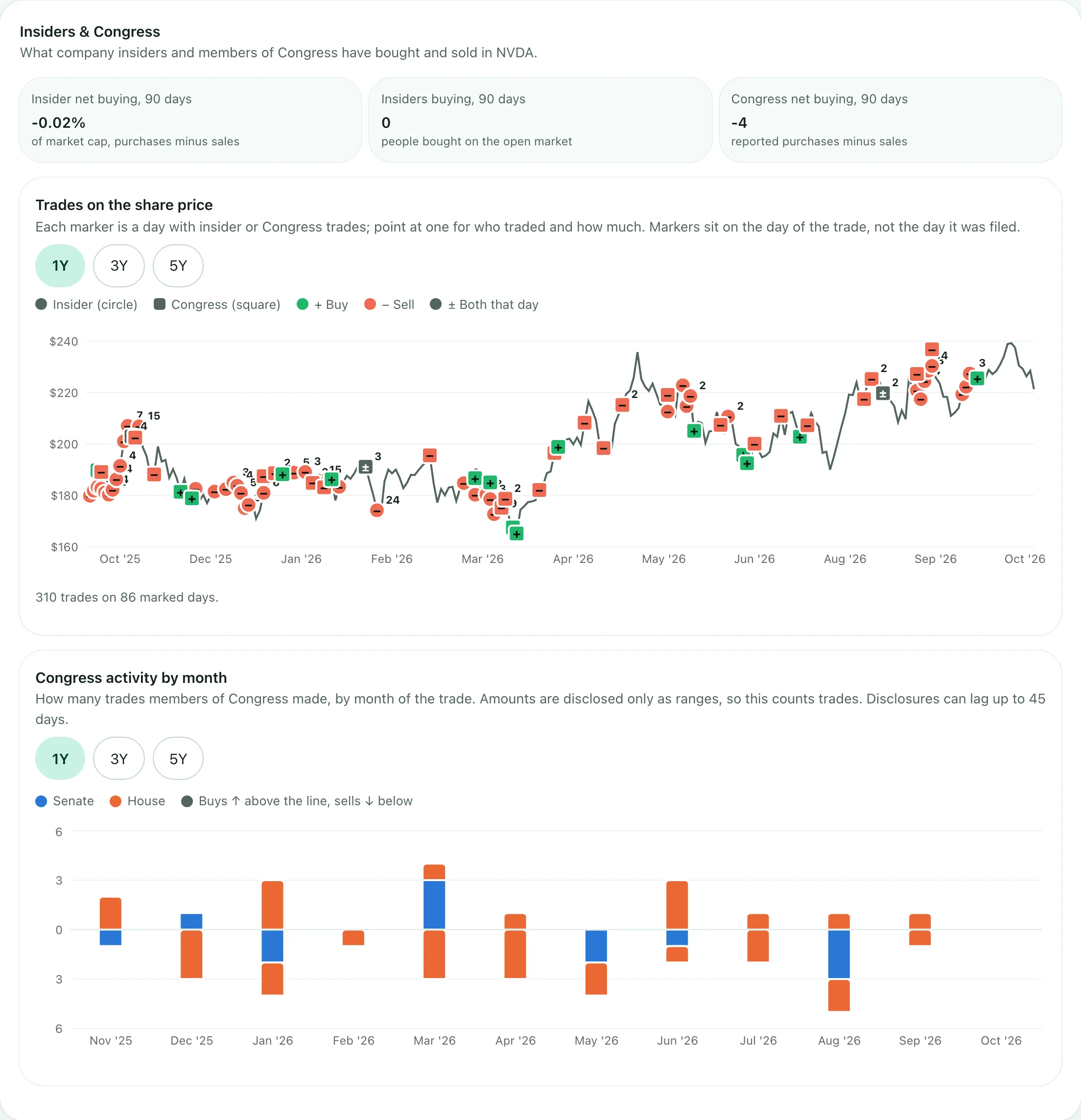
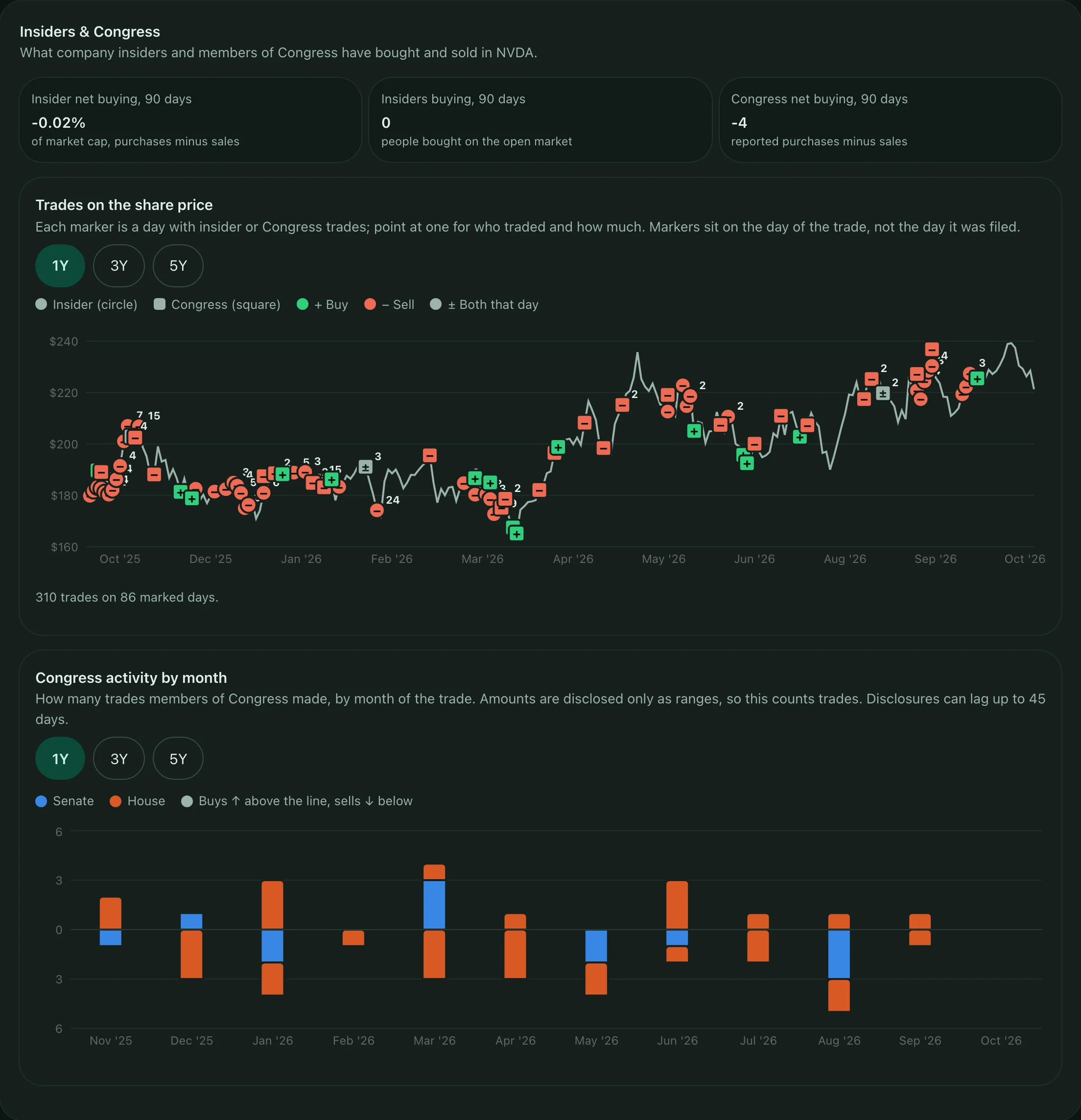
- On every stock: the stock's Insiders & Congress tab charts 5 years of Congress trades next to company insiders' purchases and sales, with the trades marked on the price chart.
The tracker in pictures
Real screens from the app, in the app's light and dark themes.
How often it updates, and how far back it goes
The trades are refreshed every weekday evening, together with the rest of Stock Meadow's data, and the tracker says when it was last updated. It holds 5 years of trades. Because members report up to 45 days late, the newest weeks are usually incomplete and fill in as reports arrive.
What the tracker leaves out
- Party. The data has no party information, so none is shown.
- Exact amounts. Members report ranges, so the tracker counts trades and does not total dollars.
- Other assets. Only purchases and sales of stocks are included.
- Today's trades. Reports arrive up to 45 days late, so a stock's price may have moved by the time a trade is public.
A trade by a member says nothing by itself about why it was made or how it will turn out, and Stock Meadow does not suggest copying anyone's trades. The tracker is a research tool, not investment advice.
Who can use it
The Congressional Trade Tracker is for members. Sign up free for a 14-day trial with no card, then $15 a month or $150 a year (see pricing). The tracker sits beside the Stock Meadow scoring models: you can score and rank stocks, then check what members of Congress have been trading.
Frequently asked questions
- What is the STOCK Act?
- The Stop Trading on Congressional Knowledge Act of 2012 requires members of Congress to publicly report their stock trades, and those of their spouses and dependent children, so that the public can see them. It is the reason this data exists.
- How late are Congress trade disclosures?
- A member must report a trade within 30 days of being told about it and no later than 45 days after it happens, so what you see is always a little behind. The tracker shows both the day of the trade and the day it was disclosed, and its Latest disclosure tile shows how recent the newest report is.
- Does the tracker show a member's party?
- No. The data Stock Meadow uses does not include party, so the tracker shows each member's chamber (Senate or House) and their state or district instead.
- How far back does it go, and how often is it updated?
- It holds 5 years of trades and is refreshed every weekday evening with the rest of Stock Meadow's data. You can look at the last 30 days, 90 days, 1 year or 5 years, counted from the day each report was filed.
- Do I need an account to use it?
- Yes, the tracker is for members. Signing up is free and starts a 14-day trial with no card needed; after that it is $15 a month or $150 a year. Without an account you can look around the rest of the app in the guest preview, but the tracker shows a sign-up prompt.
Try the Congressional Trade Tracker
Sign up free for a 14-day trial, no card needed, then open the tracker. Already a member? Go straight in.
Open the tracker